 Memorials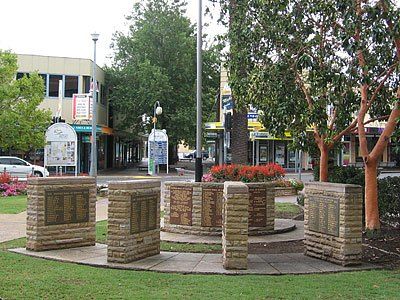
About
Penrith's Memory Park and honour roll walls were first unveiled on 8 July 1922. The memorials have been refurbished recently and were rededicated on 31 October 2008. The newer design was chosen form four different proposals submitted by artist and sculptor Terrance Plowright. A feature of the park is now the memorial sculpture. The construction used 23.5 tonnes of local sandstone, one tonne of cast bronze, 316 stainless steel plate, 11 cubic metres of concrete and steel and LED lighting with controllers. The sculpture contains four bronze figures. They were cast using the “Lost Wax Technique” and represent the Navy, Army, Air Force and Women's Royal Australian Naval Service. The central stainless steel contemporary form represents the “Eternal Flame” and incorporates 49 LED’s wired to a control unit which enables each light to flicker on and off randomly. The stainless steel ribbons at the base of the figures help tie, or lead, them back to the flame. There is LED lighting recessed within the sculpture to highlight cavities or spaces, helping to create a greater dramatic outcome. To the front left and right sides of the sculpture are four walls bearing the original honour roll tablets and later rolls and plaques. The walls each weigh approximately 2.5 tonnes. Notes on veterans' names: Those veterans given the status of 'In Memoriam' are those who are indicated as deceased on the memorial, but for whom no records of death can be found. All other status codes are from the Australian War Memorial Roll of Honour except for L S Boggs and A Richards, who are recorded as deceased on the Commonwealth War Graves Commission casualty list. The Australian War Memorial gives a Military Cross and Distinguished Conduct Medal to S Colless. C Blaxland is the great-grandson of the explorer Gregory Blaxland. V Owens is recorded on the Australian War Memorial Roll of Honour as E L V Owens, while T H Stewart is recorded as H T H Stewart.